
WELCOME BONUS 300%
UP TO €2000 + 100
FREE SPINS
UP TO €2000 + 100
FREE SPINS
Home → Blackjack
Blackjack at Alf-Casino: Variants, Rules and Payouts
RNG draws cards from virtual eight-deck shoe
The game utilizes an eight-deck shoe, a common configuration for many RNG blackjack variants. This setup aims to replicate the experience of a physical casino environment for players. The standard payout for a natural blackjack remains 3:2, offering a favorable return on winning hands.
However, some variations may alter this payout to 6:5, significantly increasing the house edge by an additional 1.39 percentage points. A $10 bet at a 6:5 table would return $12, compared to $15 at a 3:2 table. This reduction in payout directly impacts player returns on successful blackjacks.
Players should be aware of this critical payout difference, as it directly affects the overall return to player (RTP). A 6:5 payout reduces the RTP to 98.15%, whereas the standard 3:2 payout contributes to a higher RTP, such as the 99.72% seen in Blackjack Liberal Vegas Strip. Understanding these nuances is key for high rollers aiming to maximize their potential returns.
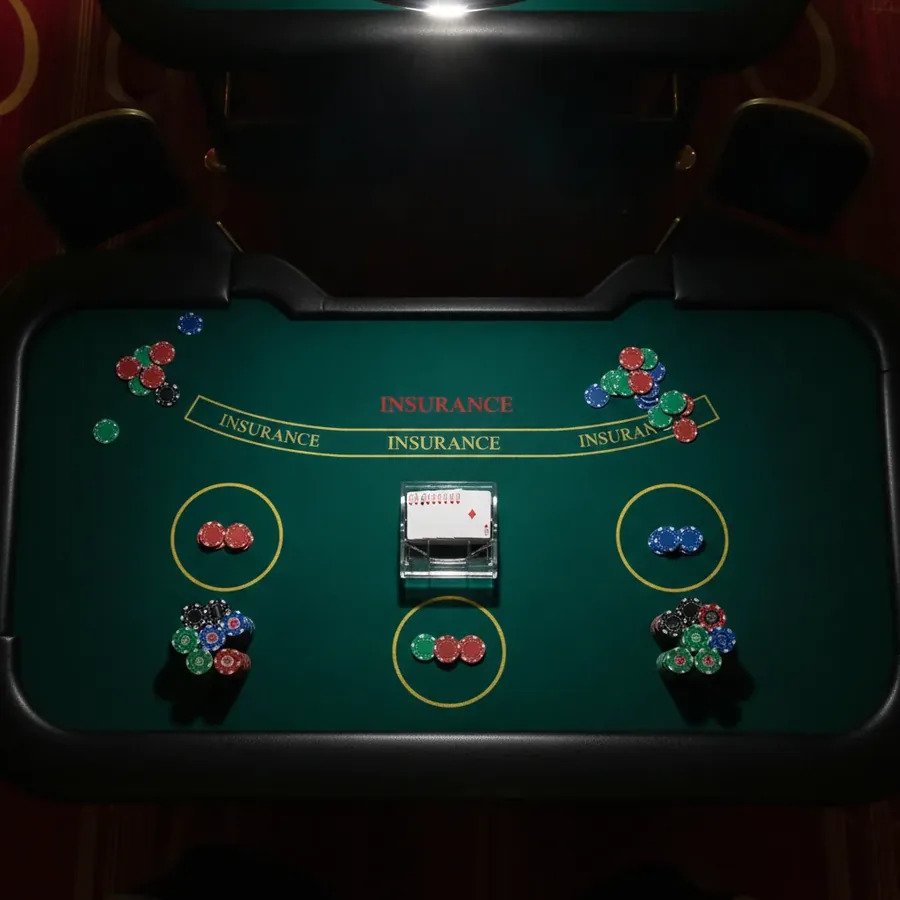
Unlimited seats via a split dealer hand
Certain blackjack variations offer unlimited seating by employing a split dealer hand. This innovative approach ensures that all players can participate simultaneously, regardless of table capacity. Live dealer options like Lightning Blackjack by Evolution support an unlimited number of players, enhancing accessibility.
This feature is particularly beneficial for high rollers who may encounter busy tables in physical casinos. With unlimited seats, players can join the action at any time. For instance, Lightning Blackjack allows for unlimited players with betting limits up to €2,500 per hand, accommodating substantial wagers.
The availability of unlimited seats, coupled with potentially high betting limits such as €5,000 in Quantum Blackjack Plus Live, creates an environment conducive to high-stakes play. This removes a common restriction found in traditional blackjack settings, allowing for more consistent engagement for serious players.
Chose Wrong Table for 5 EUR Bankroll
Selecting the appropriate table is paramount, especially when managing a bankroll. A €5 bankroll is extremely limited for high-stakes blackjack, making it difficult to engage with tables designed for larger wagers. For example, tables with maximum bets of €1,000 or €2,500 would be inaccessible.
The minimum bet on many live blackjack tables, such as Blackjack Party by Evolution, starts at €1.00. While this allows for some participation, a €5 bankroll would be depleted very rapidly with only a few losing hands, especially if faced with unfavorable rules like a 6:5 payout.
High rollers need to consider tables with higher betting limits and potentially more favorable rules to make their significant wagers meaningful. A €5 bankroll is better suited for slot games with very low per-spin costs, as table games, particularly at higher stakes, demand a substantial capital for sustained play and strategic execution.
How many decks are in the shoe?
The number of decks in the shoe significantly impacts the house edge in blackjack. A virtual eight-deck shoe is a common setup, but variations exist. For instance, a single-deck blackjack game with classic rules and a 3:2 payout offers a very low house edge of 0.15%.
Conversely, an increase in decks, such as in a 6-deck game where blackjack pays 6:5 instead of 3:2, escalates the house advantage to 1.85%. This rule change alone adds 1.39 percentage points to the casino's edge, meaning a €10 bet yields only €12 instead of €15.
High rollers should prioritize tables with fewer decks and the standard 3:2 payout for optimal results. A game with 6 decks, S17, DAS, DOA, and a 3:2 payout, played with basic strategy, offers a house edge of 0.46%. The difference between a single-deck game (0.15% house edge) and a 6-deck, 6:5 game (1.85% house edge) is substantial for consistent play.
Statistics display saves the last 100 rounds
A statistics display that records the last 100 rounds can be a valuable tool for players, particularly high rollers. This feature allows for a review of recent outcomes, potentially informing betting strategies or identifying trends. While the data itself is factual, its interpretation can vary.
For example, knowing the results of the last 100 rounds could highlight the frequency of certain hand outcomes or the performance of specific dealer upcards. This information can be cross-referenced with basic strategy principles to make more informed decisions at the table. The Quantum Blackjack Plus Live, for instance, offers multipliers that can be tracked over rounds.
However, it is crucial to remember that blackjack outcomes are largely random, and past results do not guarantee future performance. While statistics can offer insights, they do not alter the fundamental house edge or the inherent volatility of the game. The RTP of 99.57% in Quantum Blackjack Plus Live is achieved with optimal strategy, irrespective of the last 100 rounds.
Blackjack variants at a glance
| Variant | Payout | House edge | Rule | Bet range |
|---|---|---|---|---|
| Blackjack Ein Deck, klassische Regeln, 3:2 | 99.85% | 0.15% | Weniger Decks = niedrigerer Vorteil; ein Deck gibt ca. −0.48 Prozentpunkte gegenüber 8 Decks. Oft durch 6:5 Auszahlung kompensiert. | Blackjack 3:2, Gewinn 1:1 |
| Blackjack Liberal Vegas Strip (liberale Regeln, 3:2) | 99.72% | 0.28% | Günstigste Regelkombination: S17 + DAS + Resplit + Late Surrender. Standardabweichung 1,15 | Blackjack 3:2, Gewinn 1:1 |
| Blackjack Auszahlung 6:5 statt 3:2 (6 Decks) | 98.15% | 1.85% | Ersatz von 3:2 durch 6:5 fügt exakt +1.39 Prozentpunkte zum Vorteil des Casinos hinzu – stärker als jede andere Regeländerung. Bei $10 Einsatz zahlt Blackjack $12 statt $15. | Blackjack 6:5, Gewinn 1:1 |
| Blackjack Insurance / Versicherung (6–8 Decks) | 92.53% | 7.47% | Separate Nebenwette bis 50% der Hauptwette, wenn der Dealer ein Ass hat. Basisstrategie schreibt IMMER Ablehnung vor (außer Karten zählen bei True Count ≥ +3). Bei einem Deck Vorteil ≈ 5.88% | Insurance 2:1 |
| Blackjack Split / Double / H17 – Regel-Effekte | n.a. (Regel-Modifikatoren) | H17 +0.22 Prozentpunkte; RSA −0.08 Prozentpunkte; DAS −0.14 Prozentpunkte | Dealer Hits Soft 17 verschlechtert RTP um 0.22 Prozentpunkte; Resplit Aces verbessert um 0.08 Prozentpunkte; Double After Split verbessert um ca. 0.14 Prozentpunkte; 6 Decks statt 8 – ca. 0.02 Prozentpunkte. | Double – Einsatz ×2 mit einer Karte; Split – bis 4 Hände; Ass-Split meist mit einer Karte. |
| Blackjack 6 Decks, S17, DAS, DOA, Auszahlung 3:2, Basisstrategie | 99.54% | 0.46% | Dealer steht auf Soft 17; Verdopplung auf jeder Zweierkarte; Verdopplung nach Split erlaubt; keine Aufgabe. Basisstrategie ist für diesen Wert zwingend | Blackjack 3:2, normaler Gewinn 1:1, Insurance 2:1 |
Blackjack Payout 3:2 Explained in Detail
Blackjack Payout 3:2 offers a significantly better return than the 6:5 alternative. A winning hand at a 3:2 payout rate on a 100 EUR stake returns 150 EUR. In contrast, the 6:5 payout on the same stake only returns 120 EUR. This difference of 30 EUR per winning hand highlights the importance of table selection for high rollers.
The Blackjack Liberal Vegas Strip variant exemplifies favorable rules with a 3:2 payout and a low house edge. This specific game boasts an RTP of 99.72%, translating to a house advantage of just 0.28%. Such a low house edge, combined with the generous 3:2 payout, is crucial for maintaining a higher balance over extended play.
Understanding payout ratios is fundamental for strategic play. While RTP figures are theoretical, the 3:2 payout directly impacts immediate returns. For a high roller, choosing games with a 3:2 payout instead of 6:5 can reduce the casino's advantage by an additional 1.39 percentage points on each winning hand.
How long does a Live Blackjack round take?
Live Blackjack rounds offer varying durations based on the game variant and player pace. Quantum Blackjack Plus Live from Playtech, for instance, allows for bets from 1 EUR up to 5,000 EUR. The speed of play is influenced by the dealer and the efficiency of the platform, aiming to accommodate high wager amounts.
Evolution's Blackjack Party provides a lively atmosphere with two hosts, catering to a wide range of players, with bets from 1.00 EUR to 1,000 EUR. While the entertainment aspect is prominent, the core gameplay loop of dealing cards and resolving bets generally follows a standard blackjack pace. The focus is on engagement.
Lightning Blackjack, also by Evolution, accommodates an unlimited number of players with stakes ranging from 1 EUR to 2,500 EUR. This variant incorporates Lightning Multipliers of up to 25x on winning hands. The game's RTP is stated at 99.56% with optimal strategy, indicating a fast-paced, potentially high-reward environment for those betting at the higher end.
Six Decks to Eight Decks in the Shoe
The number of decks in a blackjack shoe directly impacts the house edge. A game using six decks instead of eight can offer a slight advantage, reducing the house edge by approximately 0.02 percentage points. This marginal difference can accumulate for players placing substantial bets over time.
For instance, a Blackjack 6 Decks variant with S17, DAS, DOA, and a 3:2 payout, played with basis strategy, presents a house advantage of 0.46%. This is a relatively low figure, making it attractive for high rollers seeking tables with favorable conditions. The game also features insurance paying 2:1.
In contrast, Blackjack Insurance (also known as a side bet) in a 6-8 deck shoe has a significantly higher house advantage of 7.47%. While it can be accepted up to 50% of the main bet, basic strategy dictates always rejecting it unless card counting suggests a true count of +3 or higher, making it a poor choice for most players.
When can you increase your bet?
The ability to increase your bet in blackjack often hinges on the specific rules of the table and the game's stage. Features like Double After Split (DAS) allow players to double their bet after splitting a pair, provided the initial two cards total a specific value. This rule improves the RTP by approximately 0.14 percentage points.
Blackjack Surrender offers a strategic option where a player can forfeit half of their stake after the dealer checks for blackjack. This rule modification, specifically Late Surrender, can improve the RTP by about 0.08 percentage points. High rollers may utilize this to mitigate losses on unfavorable hands.
When a player strategically employs tactics such as card counting, it can influence bet sizing decisions. For example, if a player identifies a significantly positive true count (e.g., +3 or higher), it may warrant increasing the bet size on subsequent hands. This is a more advanced strategy often employed by experienced high rollers.
Early Surrender is removed from many tables
Early Surrender, a rule allowing players to give up half their bet before the dealer checks for blackjack, is notably absent from many contemporary blackjack tables. This rule is significantly more valuable than Late Surrender, potentially reducing the house edge by up to 0.6 percentage points.
The absence of Early Surrender means players must adhere to the Late Surrender option, which is exercised after the dealer has checked for blackjack. Blackjack Surrender (Late Surrender) modifies the game such that a player forfeits half their stake after this check. This variant improves RTP by approximately 0.08 percentage points.
For high rollers, the removal of Early Surrender represents a loss of a valuable strategic tool for risk management. The standard rule modification found is Late Surrender, offering a less impactful RTP improvement. This makes finding tables that still offer Early Surrender a priority for players seeking to minimize the house advantage.
Splitting costs double bet: plan budget
Splitting a hand in Blackjack, such as with Blackjack 6 Decks, requires a doubling of the initial bet. This means a player wagering €100 would commit an additional €100 for the split hand, bringing the total wager for that round to €200. This rule is standard across most Blackjack variants, impacting the total capital required per hand played.
The decision to split is a strategic one, influenced by the player's hand and the dealer's upcard, but it directly increases exposure. For instance, if a player splits Aces, they often receive only one additional card per Ace, a restriction that can limit the potential of the split hands. Understanding this cost implication is crucial for managing betting budgets.
High rollers need to account for this doubled bet when planning their session. A player aiming to maintain a consistent betting pattern might find their available capital depleting faster when employing frequent splits. Therefore, a budget must accommodate the potential for hands to effectively cost twice the initial wager.
What Push Means: Stake Returns to You
A 'push' in Blackjack occurs when the player's hand total matches the dealer's hand total, excluding a Blackjack. In this scenario, neither the player nor the dealer wins, and the original stake is returned to the player. This outcome is a neutral result, meaning no money is lost or gained on that particular hand.
For example, if both the player and the dealer end up with a total of 18, the hand results in a push. The bet placed by the player is then returned, effectively cancelling out the wager. This contrasts with a loss, where the stake is forfeited to the casino.
Understanding pushes is vital for managing your bankroll, especially in games with a low house edge like Blackjack 6 Decks with an RTP of 99.54%. While a push does not result in a win, it prevents a loss and allows the player to continue playing with their original stake intact.
One Deck vs Eight Decks in House Edge
The number of decks used in Blackjack significantly influences the house edge. For instance, a single-deck game with classic rules and a 3:2 payout offers a superior RTP of 99.85%, translating to a house edge of only 0.15%. This is considerably more favorable to the player than games using more decks.
In contrast, a game utilizing eight decks, such as Blackjack 6 Decks (though not eight, it serves as a point of comparison for multiple decks), typically results in a slightly higher house edge. While specific RTP for eight decks isn't detailed, games with more decks generally increase the house advantage by approximately 0.02% per additional deck compared to six.
The reduction in decks from eight to one can improve the RTP by around 0.48%. This difference means that for every €100 wagered over the long term, a player could theoretically retain an additional €0.48 in a single-deck game compared to an eight-deck game, assuming all other rules remain constant.
Mobile version needs 1 Mbit bandwidth
Playing live dealer Blackjack on a mobile device, such as Quantum Blackjack Plus Live or Lightning Blackjack, requires a stable internet connection. A minimum bandwidth of 1 Mbit per second is recommended for a smooth and uninterrupted gaming experience. This ensures that the video stream and game interactions are fluid.
Lower bandwidths can lead to buffering, lag, or disconnections, particularly during critical moments in the game. For instance, while Lightning Blackjack offers multipliers up to 25x, a poor connection could prevent a player from placing their bet in time to capitalize on these features. The bet limits for these games range up to €5,000 for Quantum Blackjack Plus Live.
Ensuring your mobile device is connected to a Wi-Fi network or has a strong cellular data signal is advisable. This 1 Mbit requirement is a baseline for most live casino streaming services, allowing for timely decision-making and preventing potential losses due to technical issues.
Bonus Lost Due to 10 Percent Contribution
The welcome bonus at Alf-Casino, offering 300% up to €2,000 plus 100 free spins, has specific wagering requirements that impact its usability for table game players. Table games, including Blackjack variants, contribute only 10% towards the bonus turnover requirements. This means that for every €10 wagered on Blackjack, only €1 counts towards meeting the wagering conditions.
To illustrate, if a player receives the maximum €2,000 bonus, they would need to wager €20,000 on slots (which contribute 100%) to meet the wagering requirement. However, if they exclusively play Blackjack, the total turnover required would effectively be €200,000 (€2,000 bonus x 100 / 10%). This significantly increases the amount of play needed.
Consequently, high rollers who primarily prefer Blackjack might find it impractical to clear the full bonus amount. The substantial wagering needed via the 10% contribution means the bonus could expire before being fully converted to withdrawable cash, effectively making it less valuable for these players compared to slot enthusiasts.
Contact
Live - online chat
Banking


Providers







Alf Casino 2026